

Quick answer
A reliable stargazing forecast for La Palma combines three readings: cloud-inversion height, moon phase and upper-air wind. Skies above roughly 1,800 metres clear on most nights of the year because the trade-wind cloud deck sits below the summit. Plan around the new moon for faint objects. The Roque de los Muchachos Visitor Centre itself opens 10:00–16:00 daily — a daytime stop, not a night venue.
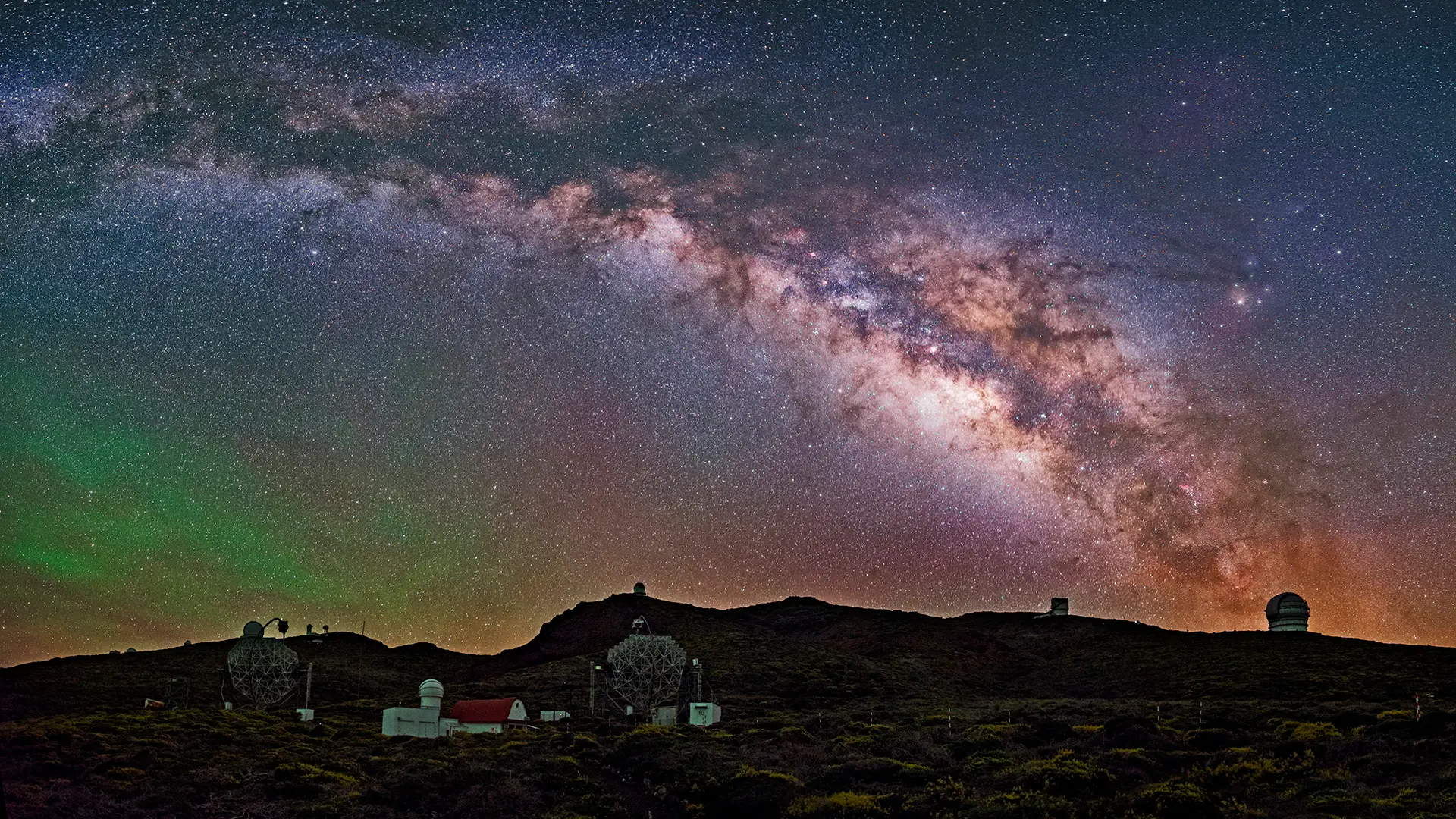
La Palma's night sky is protected by law. The 1988 Ley del Cielo, drafted specifically for this island, restricts lighting, airborne routes and radio interference above the Caldera de Taburiente — one of very few places on Earth where darkness is a legislated asset rather than an accident of geography. That legal shield, combined with an altitude of 2,426 metres at the Roque de los Muchachos, is why an accurate stargazing forecast la palma reading rarely resembles the weather app on a visitor's phone. The mechanism is the trade-wind inversion. Moist Atlantic air travelling west hits the island's eastern flank, rises, condenses and forms a stable cloud deck that usually caps out between 1,200 and 1,800 metres. Above that ceiling the atmosphere is dry, laminar and exceptionally steady — the quality astronomers call seeing. A visitor standing in drizzle at sea level in Santa Cruz de La Palma may therefore be standing below, not inside, the weather. Reading a pronóstico astronómico La Palma correctly means checking the inversion height first, then the calima, the Saharan dust haze that occasionally drifts north and does more to spoil a night than ordinary cloud ever will. Moon phase is the second variable and the only fully predictable one. The Milky Way core, visible through the summer months and still well placed in August, washes out badly within four days either side of a full moon. Serious observers on the island plan around the new moon window; casual visitors often prefer a first-quarter evening, when lunar craters are sharp along the terminator and the drive down is less disorienting. Wind is the third: gusts above roughly 50 km/h on the summit ridge make the exposed miradores genuinely unpleasant and close the access road on the worst nights. The practical sequence, then, runs backwards from the sky. Choose the date by moon phase, confirm it three days out against inversion and dust readings, and treat the island's own microclimates as an escape route — if the north is clouded above the deck, the southern volcanic ridges near Fuencaliente often are not. Daytime and nighttime plans should be kept separate, since the Visitor Centre operates on daylight hours while the observatory domes above it work through the dark. Used this way, a stargazing forecast la palma check becomes a scheduling tool rather than a gamble, and the island's Starlight Reserve status stops being a slogan and starts being a plan.
“A visitor standing in drizzle at sea level may be standing below the weather, not inside it.”
Seasonal and Daily Factors for Your Stargazing Forecast La Palma
The period between April and October provides the most stable atmospheric conditions for observing the night sky in La Palma. Planning your visit to the Roque de los Muchachos Visitor Centre during this time ensures clearer visibility and higher chances of optimal stargazing conditions.
April to June
Low18°C–22°C; stable sky
Dry conditions and clear nights provide excellent astronomical viewing. Moderate temperatures make outdoor observation comfortable.
July to August
High22°C–26°C; clear
High pressure systems maintain consistent, cloud-free nights. These months see increased visitor density during the day.
September to October
Low20°C–24°C; calm
The atmosphere stabilizes further, offering high transparency for deep-sky observation. Lower visitor numbers allow for a quieter experience.
Daily Arrival
Optimal at 10:00—
Arriving within the best arrival window of 10:00–15:00 allows sufficient time to utilize the visitor centre's resources before sunset.
Verdict: For the best balance of stable weather and fewer crowds, aim for a mid-week visit during April or October, arriving promptly at 10:00.
Operating Hours for the Stargazing Forecast La Palma Visitor Centre
The Roque de los Muchachos Visitor Centre operates with consistent daily hours throughout the week. Visitors can access the facility during these scheduled times to explore the exhibition.
| Monday | 10:00–16:00 | |
|---|---|---|
| Tuesday | 10:00–16:00 | |
| Wednesday | 10:00–16:00 | |
| Thursday | 10:00–16:00 | |
| Friday | 10:00–16:00 | |
| Saturday | 10:00–16:00 | |
| Sunday | 10:00–16:00 |
How to Reach Your Stargazing Forecast La Palma Observation Point
The Roque de los Muchachos Visitor Centre is located at Carretera LP-4, Km 37, 38729 Garafía, Santa Cruz de La Palma, Spain. Access is exclusively by road, requiring a drive up the mountain via the LP-4 highway.
LP-4 highway from Santa Cruz de La Palma
Local taxi service to Roque de los Muchachos
Essential Preparation for Your Stargazing Forecast La Palma Trip
The Roque de los Muchachos Visitor Centre sits above 2,000 metres, so a little preparation weeks ahead makes the difference between a comfortable visit and a cut-short one.
-
Reserve your visit slot in advance — Capacity at the centre is limited and weekend slots fill early.
-
Check the Roque road status beforehand — Snow, ice or fog can close the LP-4 with little notice.
-
Carry photo ID for each visitor — Named reservations are checked on arrival at the entrance.
-
Pack an insulated jacket and gloves — Summit temperatures often run 10-15C below the coast, even in summer.
-
Wear closed walking shoes with grip — The terrain around the centre is loose volcanic rock, not paving.
-
Bring at least 1.5 litres water — The dry, thin air at altitude dehydrates faster than you expect.
-
Add sunglasses, sunscreen and lip balm — UV exposure is intense above the cloud layer.
-
Aim to arrive between 10:00-15:00 — This avoids crowds and leaves enough time for the exhibition.
Check availability
Frequently Asked Questions About Stargazing Forecast La Palma
Everything you need to know about stargazing forecast la palma