

Quick answer
The Roque de los Muchachos Visitor Center is open 10:00–17:30 daily, with 10:00–17:00 the recommended arrival window, because nighttime site access is restricted. Entry to the Visitor Center area is free; guided tours require separate booking. For the sky itself, moonless nights in the drier months give the darkest conditions — cloud inversion below the ridge helps year-round.
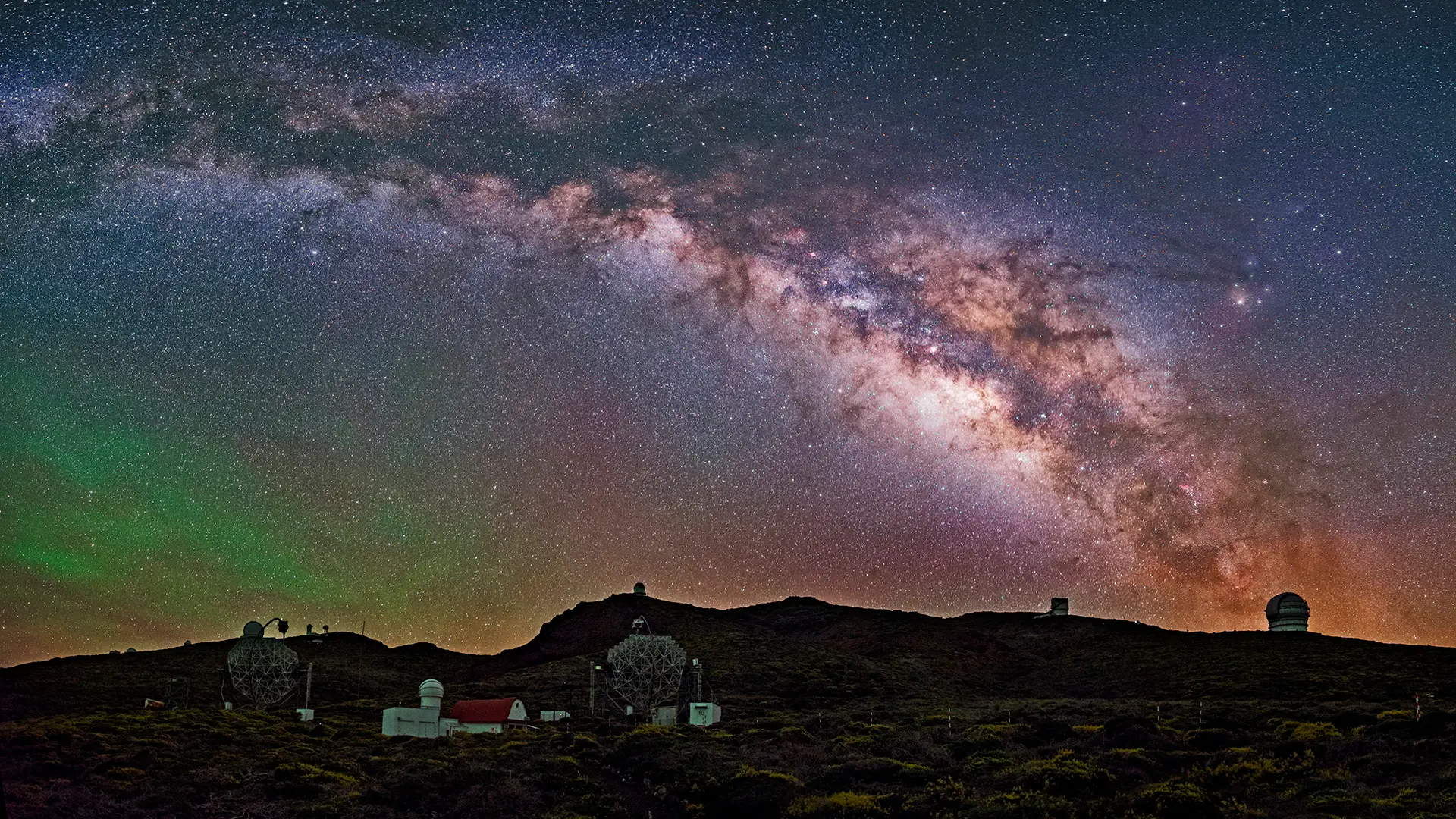
The island passed Europe's first law protecting a night sky in 1988, and it still governs the amber sodium lighting in Santa Cruz de La Palma, the flight paths overhead, and the radio silence around the summit. That law is the reason the best time for stargazing la palma delivers is measured in moon phases rather than months alone: light pollution, the variable that ruins most sites, was removed from the equation nearly four decades ago. What remains is weather, altitude, and the calendar of the moon. The Roque de los Muchachos ridge rises to 2,426 metres, high enough to sit above the sea of cloud that the trade winds pile against the northeast flank. Visitors driving up from the coast often pass through grey drizzle at 1,200 metres and emerge into clear air twenty minutes later. That temperature inversion is the engineering reason the Gran Telescopio Canarias, the Nordic Optical Telescope and the MAGIC gamma-ray dishes were built here. It is also why an overcast forecast at sea level tells a visitor almost nothing about conditions on the ridge. The one genuine spoiler is calima, the Saharan dust haze that drifts west across the Canary Islands and turns the horizon milky for days. The practical constraint is access. The summit is a working scientific facility under the Instituto de Astrofísica de Canarias, not a public viewpoint that stays lit after dark, and the road up is narrow, unlit and exposed. Astronomical tourism on La Palma therefore splits in two: daytime visits to the observatory complex, and separate night-sky sessions run from designated mirador sites lower down the mountain, where guides bring telescopes and no facility access is needed. Understanding that split is what makes any best time for stargazing la palma guide useful rather than academic. So the reader planning a trip should work backwards from the lunar calendar first, choosing a window near new moon, then check the calima outlook in the days before travel, then decide whether the daytime observatory visit and the night session happen on the same day or different ones. Those dedicated sections below cover the schedule, the fees and the drive in detail. The sky, unlike the road, asks only for patience and a dark hour.
“Light pollution, the variable that ruins most sites, was removed from the equation nearly four decades ago.”
The Best Time for Stargazing La Palma: Seasonal and Daily Windows
La Palma offers exceptional sky clarity throughout the year, but the most favorable conditions for deep-sky observation occur during the new moon phases in autumn and spring. While the Visitor Center operates during daylight hours, nighttime access is restricted, requiring careful coordination with professional stargazing excursions.
Spring (March–May)
ModerateClear skies, 15°C to 20°C
Stable atmospheric conditions provide excellent visibility for planetary observation.
Autumn (September–November)
ModerateMild temperatures, 18°C to 22°C
This period offers high transparency and minimal Saharan dust interference.
Summer (June–August)
HighWarm nights, 20°C to 25°C
Longer days limit darkness, though summer skies are ideal for observing the Milky Way core.
Winter (December–February)
LowCooler, 12°C to 17°C
Occasional clouds can occur, but the altitude above the inversion layer often remains clear.
Verdict: The best stargazing windows are during the new moon phases in April or October, when atmospheric stability is at its peak.
Opening Hours for the Best Time for Stargazing La Palma Planning
The Visitor Center at Roque de los Muchachos operates on a consistent schedule throughout the week to facilitate visitor access.
| Monday | 10:00–17:30 | |
|---|---|---|
| Tuesday | 10:00–17:30 | |
| Wednesday | 10:00–17:30 | |
| Thursday | 10:00–17:30 | |
| Friday | 10:00–17:30 | |
| Saturday | 10:00–17:30 | |
| Sunday | 10:00–17:30 |
Admission Fees When Considering the Best Time for Stargazing La Palma
Access to the Roque de los Muchachos Visitor Center is provided without an admission fee. Please note that participation in guided tours of the facility requires separate arrangements.
A typical visitor pays 0 EUR for center access, while guided tours incur costs based on independent booking.
Directions and Logistics for the Best Time for Stargazing La Palma
The Roque de los Muchachos Observatory is located in the northern region of La Palma, accessible primarily by private vehicle. Navigating the winding mountain roads requires careful planning to ensure safe arrival at the summit.
LP-4 road via Santa Cruz de La Palma
LP-4 road via Garafía
Private hire from Santa Cruz de La Palma
Pre-Visit Checklist for the Best Time for Stargazing La Palma
The Roque de los Muchachos sits above 2,300 metres, so preparation here is mostly about altitude, cold and darkness rather than paperwork.
-
Book guided tours in advance — Guided tours require separate booking and night access to the site is restricted.
-
Confirm details with the observatory — Call +34 922 40 55 00 or check https://www.iac.es before travelling, as summit access can close in bad weather.
-
Pack insulating layers and windproof shell — Summit temperatures drop sharply after sunset and wind exposure is constant year-round.
-
Add hat, gloves and warm socks — Standing still for long periods at altitude cools extremities fast.
-
Bring a red-light headlamp — Red light preserves night vision and avoids disturbing other observers and instruments.
-
Carry water and light snacks — Altitude increases dehydration, and there are no shops at Roque de los Muchachos.
-
Fill the fuel tank beforehand — The summit road is long and unlit, with no fuel stations near the site.
-
Download offline maps and forecasts — Mobile coverage on the ridge is patchy and cloud levels change quickly.
Check availability
Frequently asked questions about best time for stargazing La Palma
Everything you need to know about best time for stargazing la palma